Concrete vs Clay Roof Tile in Central Florida
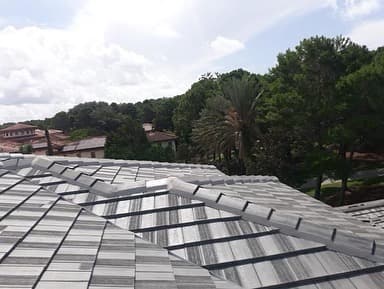
Two Tiles, Different Materials
Clay tile is fired earth. The colour is the material itself, produced by the clay body and the firing, not applied to the surface.
Concrete tile is moulded from sand, cement and water, with pigment mixed through and usually a surface coating as well.
Both are excellent roofing materials for Central Florida. Both routinely outlast the underlayment beneath them. The differences show up in weight, appearance over time, and price.
Weight
Concrete is heavier — commonly in the region of 900 to 1,100 pounds per square, against roughly 600 to 850 for clay, depending on profile.
On a house designed for tile, neither is an issue. On a home originally built for asphalt shingle, the structure needs assessing before either goes on, and the difference between the two can matter to that assessment.
This is the first question to settle, because it can rule out an option before aesthetics enter the discussion.
Colour Over Time
This is where the two genuinely diverge.
Clay holds colour effectively forever. The pigment is fired through the body. A clay tile roof at thirty years looks materially like it did at one, allowing for some patina.
Concrete fades. The pigment is mixed in and the surface coating weathers, so the colour softens over a couple of decades in Florida sun. Not unattractive — many people prefer the aged look — but it is a change, and it is not reversible without coating the roof.
If matching a specific colour matters long-term, clay is the more predictable choice.
Cost
Concrete is generally less expensive per square, often meaningfully so. Clay carries a premium for the material itself, and certain profiles and imported products carry a considerable one.
Installation labour is comparable, and on a tile roof labour and underlayment are a large share of the total. The material difference is real but smaller as a proportion of the finished job than the raw tile prices suggest.
Durability and Failure Modes
Both are inert under UV and neither rots. Their failure modes are similar and mostly mechanical.
Breakage from impact or foot traffic is the main one. Clay is somewhat more brittle; concrete is tougher but heavier when it does come loose.
Slipped or displaced tiles after high wind, usually at the perimeter or ridge.
Underlayment failure — and this is the one that actually determines the roof's life. The tile is a rain shield and a wear surface; the underlayment is the waterproofing. In Florida the underlayment typically gives out at twenty to thirty years while the tile is still perfectly serviceable.
That is why a tile roof is often *re-underlaid* rather than replaced: the tile is carefully lifted and stacked, new underlayment goes down, and the original tile is reinstalled with breakage replaced. It is labour-intensive but far less costly than new tile throughout.
Which To Choose
Choose clay if long-term colour stability matters, if the aesthetic you want is specifically a clay one, and if weight is a consideration on your structure.
Choose concrete if budget is a significant factor, if you want a broader range of profiles including ones that imitate wood shake or slate, and if your structure comfortably carries the load.
Either way, the decisions that determine how long the roof lasts are the underlayment specification, the fastening method, and the quality of the flashing at valleys and penetrations. Those matter more than which tile sits on top.
We install tile roofing in Heathrow, tile roofing in Lake Mary, tile roofing in Lake Nona and tile roofing in Howey-in-the-Hills.
One Practical Warning
Whichever you have, keep foot traffic off it. Tile cracks under weight, frequently without any visible sign, and the crack becomes a leak a season or two later. If satellite installers, painters or solar crews need roof access, they should know how to walk tile — or they should not be up there.